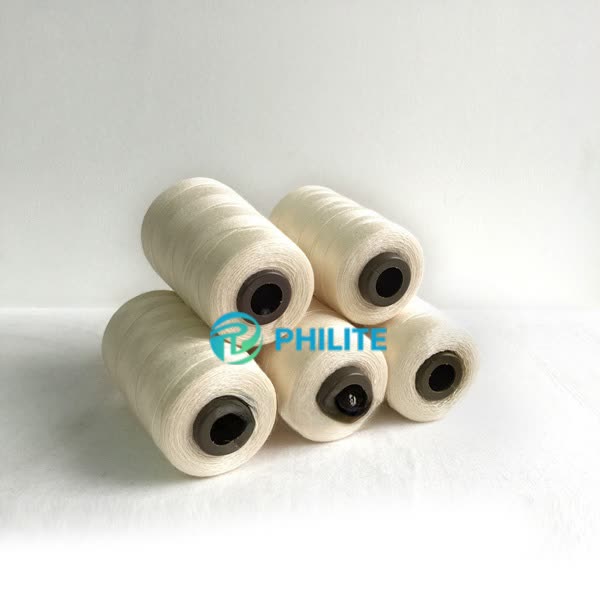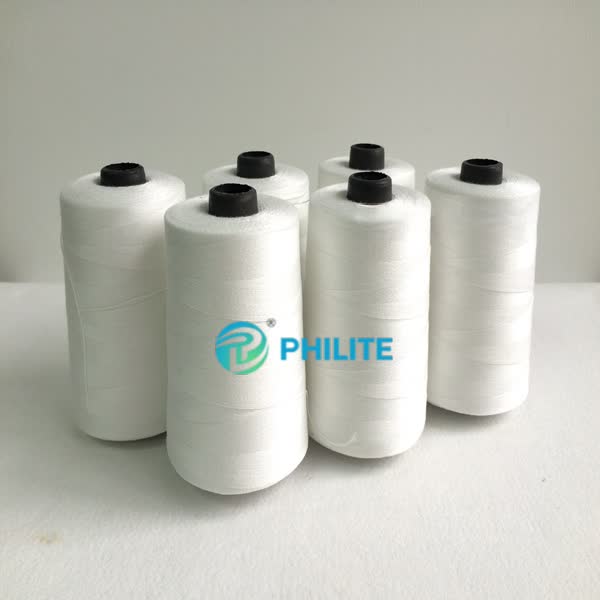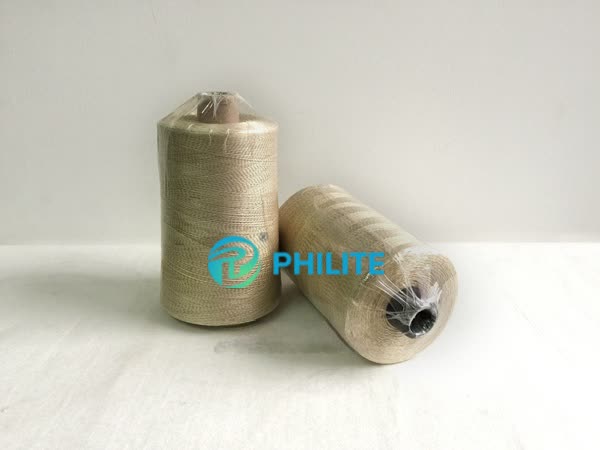
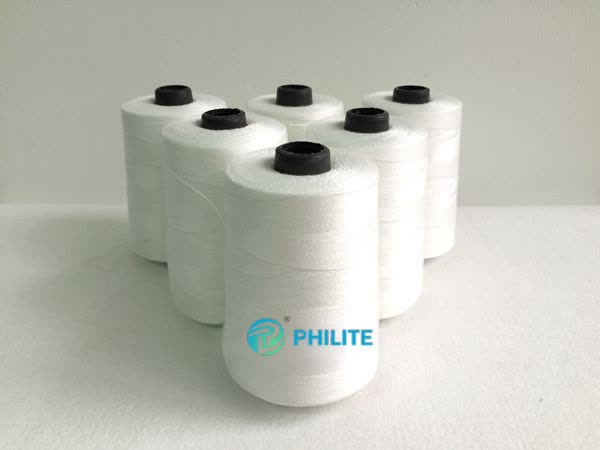
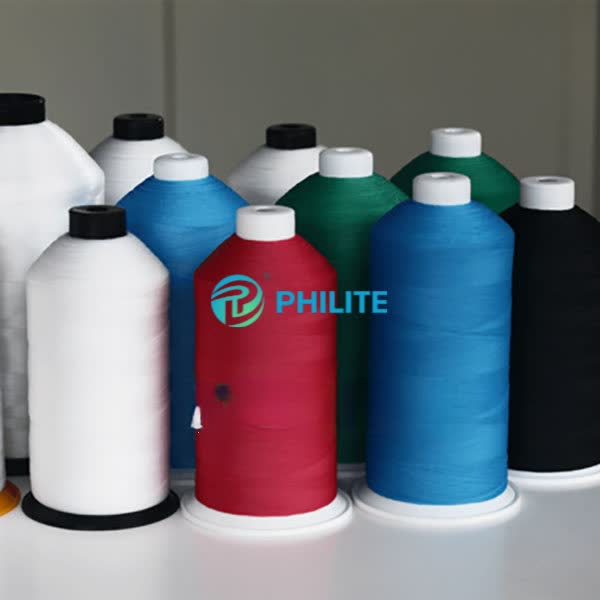
PTFE Sewing Thread
Advantages of our PTFE sewing thread:
- The continuous high temperature resistance of PTFE itself can reach 260 ℃.
- PTFE has strong corrosion resistance and can adapt to harsh working conditions.
- Superior tensile strength.


Color PTFE Sewing Thread:
We also provide color PTFE sewing thread. Color sewing thread is made by a unique blending technology by adding nano fluoro based pigments to PTFE dispersion resin. The product has the characteristics of full color, oxidation resistance, and high fastness to sunlight while maintaining excellent resistance to temperature and corrosion.- Application: Color sewing thread is mainly used for sewing special industrial powder (mineral powder) collection filter bag, dust filter bag, screen identification, sailing sail, sunshade tarpaulin and etc.
- Specification: The density specification of color sewing thread is 1350-5500dtex. Meanwhile, the special color can be customized.
Application of PTFE sewing thread:
- Sewing in high-temperature environments: Used in situations where it is necessary to withstand high-temperature environments, such as in the manufacturing industry for sewing equipment, stoves, pipes, etc. in high-temperature processes.
- Chemical industry: Due to the chemical resistance of PTFE, it is widely used in the chemical industry to sew equipment or containers that need to come into contact with corrosive chemicals.
- Food processing industry: It is often used in the food processing industry because it is a non-toxic material that does not release harmful substances and is suitable for sewing food processing equipment.
- Medical industry: In medical device manufacturing, it is often used to sew high-temperature sterilization equipment, laboratory equipment, etc.
- Aerospace field: It is widely used in the aerospace field for sewing aircraft engine parts, spacecraft heat shields and other equipment in high-temperature environments.
- Glass Manufacturing: In the glass manufacturing process, it is often used to sew glass furnaces, fiberglass production equipment, etc. because it can withstand high temperatures and chemical corrosion.
- Electronics industry: In the electronics industry, it is often used for sewing high-temperature equipment, electronic component manufacturing equipment, etc.
Notifications:
- Please do not use an open fire to burn it during using the product in case of the generation of harmful gas to the human body.
- The product waste is not degradable and will cause environmental pollution, do not mix it with ordinary garbage or burn it. Please collect and recycle it by a professional company.
- PTFE material is a non-petrochemical product, which is manufactured as non-renewable mineral resources with high value. Please pay attention to economical use.
- According to the standards of the China Industrial Textile Industry Association and international practices. Dtex refers to the mass of a certain unit length(G/L). Another unit of linear density commonly used in the industry, “den”(Daniel), refers to the mass of 9000 meters in length. (1den=0.9dtex)
产品详细描述
PTFE sewing thread is made of 100% polytetrafluoroethylene resin material with high-quality temperature resistance(-196~260℃), corrosion resistance, hydrolysis, oxidation resistance, and other properties.
Main features of PTFE sewing thread:
- High temperature resistance: PTFE has excellent high temperature resistance and can be used at extremely high temperatures (usually above 200°C) for extended periods of time without melting or decomposing.
- Chemical resistance: PTFE has good corrosion resistance to most chemicals, so it can be used safely in chemically corrosive environments.
- Non-sticky: PTFE is a material with good non-stickiness and is not easy to adhere to dust, dirt and chemicals, making the sewing thread less likely to clump or break during use.
- Tensile strength: PTFE sewing thread usually has high tensile strength and is suitable for sewing items that need to withstand large tensile forces.
- Wear resistance: PTFE sewing thread has good wear resistance and is not easily worn or broken due to friction.
Specification:
| Technical parameters of PTFE sewing threads(1) | ||||
| Model: ST-EF/1350/3-a | ||||
| No. | Parameter | Value | Test Temperature | Notes |
| 1 | Linear density | 1350±50dtex | Ambient temperature | 1200D |
| 2 | Breaking strength | ≥36N | <20℃ | |
| 3 | Breaking tenacity | ≥2.6cN/dtex | <20℃ | |
| 4 | Elongation at break | 4-10% | <20℃ | |
| 5 | Heat-shrinkage rate | ≤3% | 260℃/2h | |
| 6 | Yarn | 3 | ||
| 7 | Average mass per one meter | 0.135g/m | ||
| 8 | Length per kilometers | 7500m | ||
| 9 | Net weight/spool | 800-1000g | Without knots | |
| Technical parameters of PTFE sewing threads(2) | ||||
| Model: ST-EF/1650/3-a | ||||
| No. | Parameter | Value | Test Temperature | Notes |
| 1 | Linear density | 1650±60dtex | Ambient temperature | 1500D |
| 2 | Breaking strength | ≥39N | <20℃ | |
| 3 | Breaking tenacity | ≥2.3cN/dtex | <20℃ | |
| 4 | Elongation at break | 4-10% | <20℃ | |
| 5 | Heat-shrinkage rate | ≤3% | 260℃/2h | |
| 6 | Yarn | 3 | ||
| 7 | Average mass per one meter | 0.165g/m | ||
| 8 | Length per kilometers | 6000m | ||
| 9 | Net weight/spool | 800-1000g | Without knots | |
| Technical parameters of PTFE sewing threads(3) | ||||
| Model: ST-EF/2000/4-a | ||||
| No. | Parameter | Value | Test Temperature | Notes |
| 1 | Linear density | 2000±1000dtex | Ambient temperature | 1800D |
| 2 | Breaking strength | ≥49N | <20℃ | |
| 3 | Breaking tenacity | ≥2.45cN/dtex | <20℃ | |
| 4 | Elongation at break | 4-10% | <20℃ | |
| 5 | Heat-shrinkage rate | ≤3% | 260℃/2h | |
| 6 | Yarn | 4 | ||
| 7 | Average mass per one meter | 0.2g/m | ||
| 8 | Length per kilometers | 5000m | ||
| 9 | Net weight/spool | 600-800g | Without knots | |
Several reasons to choose PTFE sewing thread produced by PHILITE
- We accept customized PTFE thread in various colors
- We can produce various specs including 1200D, 1500D, 1800D and 2400D, etc.
- As for the common PTFE thread specification 1200D, the weight of our one bobbin is 800 – 1000 g, and the length of each bobbin is about 7500 m.
- We use neutral carton packaging and then fix it on a plywood pallet to ensure the integrity of the product during transportation.
- The single strand of this product is manufactured by the extruding process, with circular diameter, uniform and full trace, small shrinkage, stable elongation, and large continuous length(the maximum weight specification of 1350dtex conventional line is 1000g/spool and continuous length is 7500m), which is suitable for high-speed sewing machines. In addition, in order to enhance the fastness of stitching, 1650dtex(1500D), 2000dtex(1800D), 2650dtex(2400D) for bag top, bag bottom and other special specifications are equipped.
- In order to ensure the fastness of sewing, this product is made of “long filament” without any bonding and stitching methods. the length of the sewing thread is artificially increased to ensure the safety of the sewing thread and the safety of the filter bag.
- Because PTFE material has a very strong self-lubrication property and extremely low friction coefficient, if there is a stitch jumping during sewing, an appropriate amount of silicone oil can be coated on the sewing line to prevent this situation from happening.
- Due to the particularity of the manufacturing process, there is a 10% error range in linear density and strength parameters.
相关产品